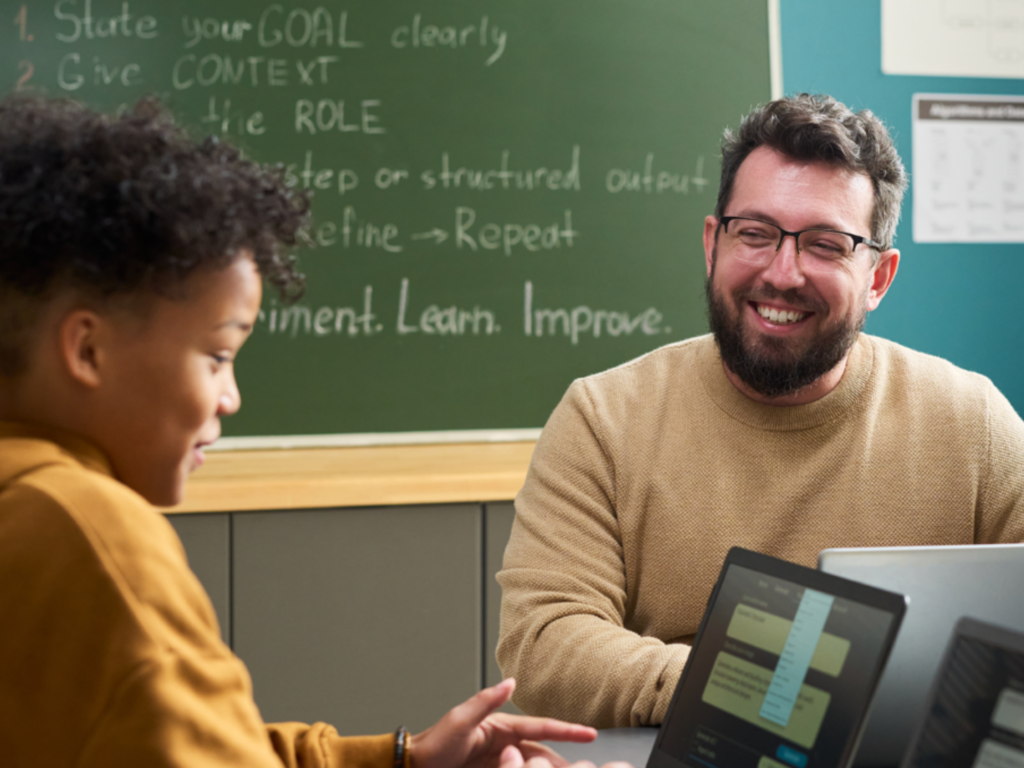
AI is one of the most talked-about — and least understood — technologies in K-12 education today. While some see it as a silver bullet and others as a threat, NewSchools is taking a different stance: grounded optimism.
Unlike those pushing rapid adoption or quick technical fixes, we focus on learning outcomes, educator voice, and practical implementation. We invest in early-stage ventures that use AI not to replace educators, but to elevate them, and to unlock better learning experiences for all students.
That work has given us a front-row seat to what’s promising, what’s challenging, and what’s needed next. Here’s our perspective on AI in K-12 education, what we’re learning from our portfolio, and why we believe new technologies must be built with the people they’re meant to serve.
What We Believe
We see AI as a powerful but imperfect tool. Its greatest potential lies in expanding student access to grade-level content and personalized support, strengthening teacher practice, enabling timely, actionable assessments, and ensuring every student — including multilingual learners, students with learning differences, and those furthest from opportunity — is well supported.
Used thoughtfully, AI can reduce administrative burdens, strengthen instructional feedback loops, and help educators focus on what matters most: inspiring curiosity, building relationships, and helping every student believe in their potential. But to achieve this, tools must be designed for people, not just efficiency.
Our approach combines funding innovation and building school capacity to adopt AI responsibly. That means improving AI literacy across school systems, supporting co-creation with educators and students, and addressing systemic risks like bias and cognitive offloading.
All of our investments are guided by four principles:

Quality over speed
We prioritize solutions that demonstrate instructional value over those that race towards rapid growth.

Co-creation with educators and students
We invest in ventures that design and test solutions to work in real classrooms.

Instructional coherence and rigor
We look for solutions that align with strong pedagogy and reinforce effective instructional practices.

Inclusive design from the start
We seek solutions that reflect the range of student needs and are accessible to all learners.
What We’re Seeing
The field is moving fast, often without clear direction. Many schools feel pressured to adopt AI tools, yet lack the guidance, infrastructure, or know-how to implement them effectively. Across our conversations with educators and innovators, we’re seeing three tensions that demand more attention:
- Limited evidence. Most AI solutions are new, with limited research behind them. Educators still need clarity on what works — and for whom.
- Capacity gaps. Teachers and system leaders are stretched thin. Without implementation support, even promising AI solutions can fall short.
- Efficiency over impact. Some AI solutions chase speed and automation over meaningful learning. We’re keeping our focus on quality and outcomes.
Despite these challenges, we’ve found bright spots. We’re encouraged by the creativity and momentum among innovators building solutions that strengthen instruction. We’re learning alongside them and focusing our investments where AI can deliver the most value for students and educators.
How We’re Showing Up
Over the past five years, we’ve funded more than 50 ventures using AI as a catalyst for better teaching and learning.
These ventures are already showing how AI can be applied in the areas where we see the most promise — from expanding student access to grade-level content, to improving teacher practice, delivering more actionable assessments, and strengthening supports for students furthest from opportunity.
A few examples:
- Coursemojo helps students engage with high-quality instructional materials and receive real-time feedback that deepens their understanding.
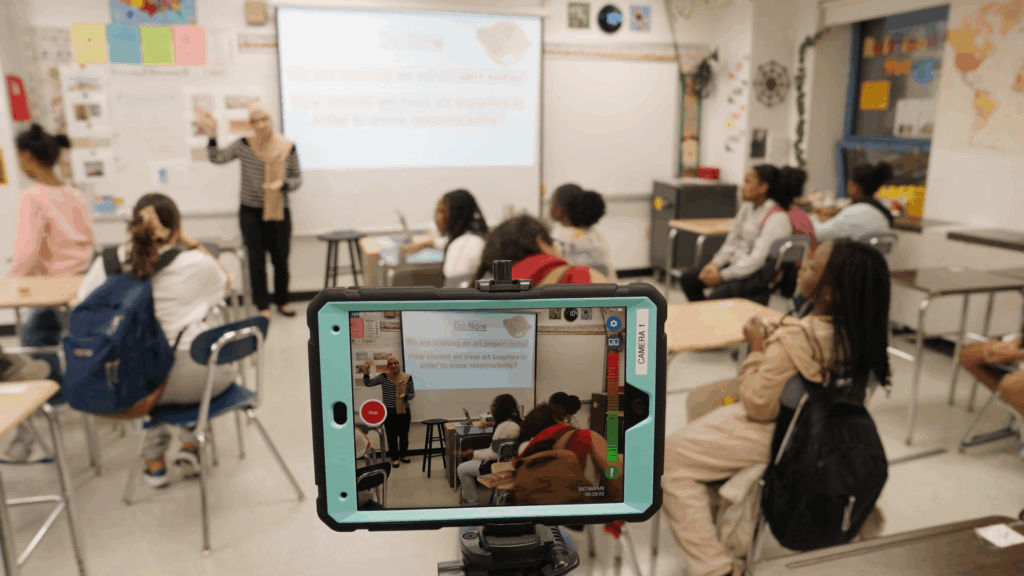
- Urban Assembly’s Project CAFE enables teachers to reflect on and refine their craft using classroom video
- Uppercase tailors professional learning and matches teachers with coaches for timely, practical support.
- EdLight analyzes student work to generate nuanced insights that inform instruction.
- Uprooted Academy uses AI to broaden access to postsecondary options for students with learning differences.
The Future We’re Working Toward
We’re continuing to learn with educators, developers, and researchers to identify where AI can make the biggest difference in classrooms. That means benchmarking tools, sharing insights from the field, and understanding the conditions that enable effective adoption.
Our focus remains on mission-driven developers who share our principles, address real classroom needs, and apply AI to strengthen relationships, deepen learning, and support the human connections that make education work. We invite educators, innovators, and funders to continue setting a high bar for impact that ensures AI is built for the classroom, grounded in evidence, and always centered on people.
Featured image credit: Urban Assembly