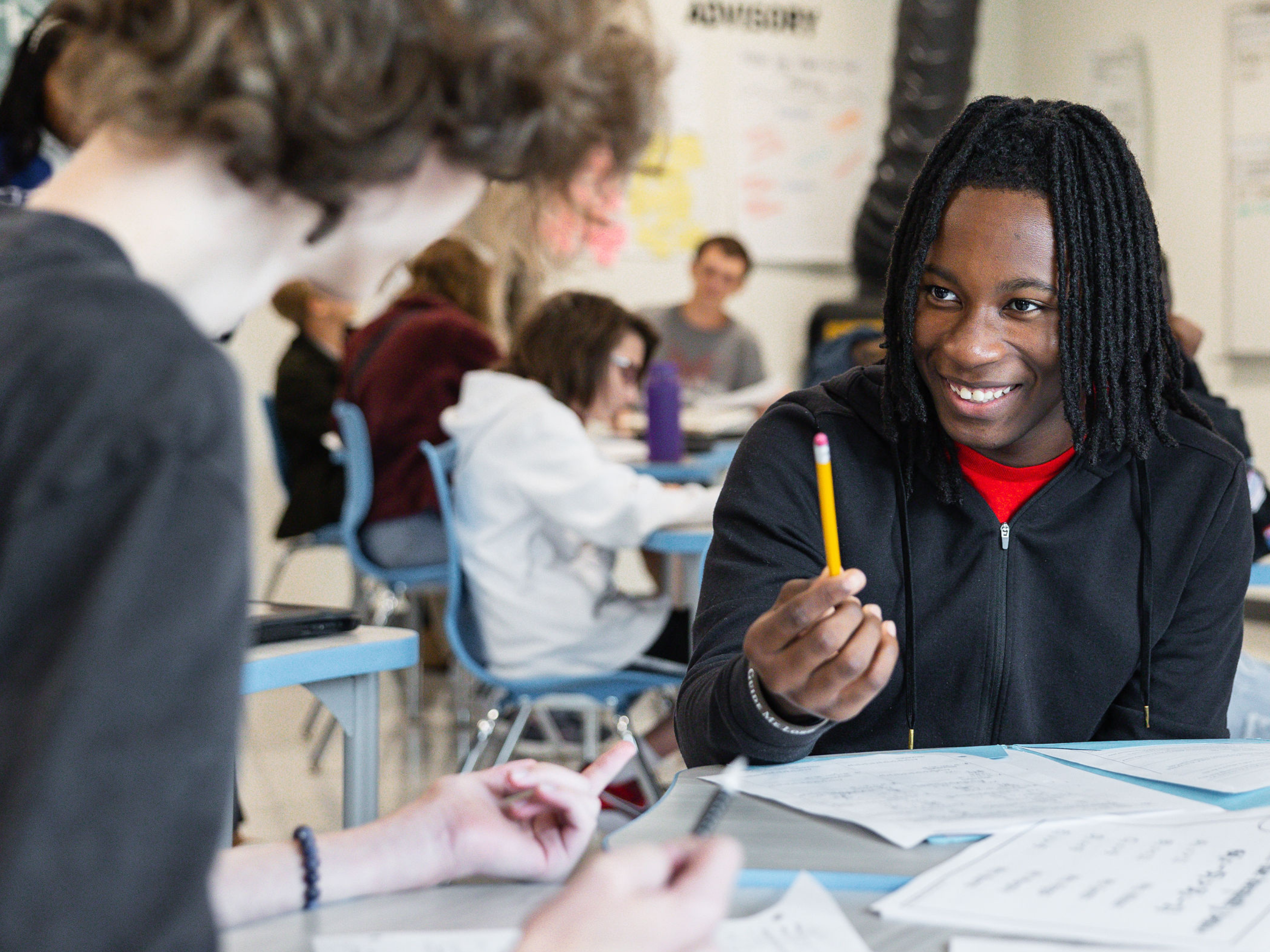




In Houston’s Aldine Independent School District, about 800 students new to the country enroll in middle and high school each year, and their dropout rate was once projected to reach 50 percent by 2027. La Promesa – “The Promise” in Spanish – is an innovative high school created to change that trajectory, with a pledge that every student will graduate and reclassify as a former English learner.
Unlike typical Texas models that shuffle English learners once they reach proficiency, La Promesa maintains cohorts together through graduation, providing continuity as students navigate academic challenges and a new culture. The school rejects false choices between English acquisition and academic rigor, cultural preservation and U.S. integration, or education and work. Instead, it maintains high academic expectations, celebrates students’ multilingual assets, and prepares them for college and careers while honoring family economic realities.

La Promesa was built with the community. In 2020, Aldine ISD asked families what they needed, conducting extensive empathy interviews with students, parents, and teachers. A districtwide survey drew more than 13,000 responses: 80% expressed the need for a school designed for students new to the country and 90% supported dual-language programming. The community had spoken, and La Promesa was born from their collective voice.

La Promesa operates on four interconnected principles that guide every classroom decision and school practice: integrated language and content instruction; experiential learning; relationship building through goal setting; and cultural identity as an asset.
Students build English proficiency while simultaneously mastering grade-level academic work through systematic language-content integration routines that are implemented across all grade levels and subject areas. Experiential, hands-on investigations ensure content understanding precedes language demands. These include activities such as dissecting flowers before learning botanical vocabulary or conducting chemistry experiments before writing lab reports.
Individual relationships anchor academic work through biweekly goal-setting conferences where teachers and students collaborate to establish goals for academics, mindsets, and habits; track progress through data; and engage in student-led discussions about growth. Throughout the learning process, cultural identity becomes an asset rather than an obstacle, with built-in celebrations of students’ native languages through courses like AP Spanish Literature and regular opportunities for students to share their stories and cultural knowledge as part of rigorous academic investigations.
 |
 |
 |


Innovative schools need to build critical support roles early on, before growth pressures set in. In 2023, La Promesa learned this when it lost an Instructional Specialist who supported student language development during a period of rapid expansion. The vacancy created a cascade that directly affected classrooms: Texas English Language Proficiency Assessment System (TELPAS) scores declined from prior years’ highs even as academic scores continued to rise.
La Promesa responded by filling the specialist role and adding an Assessment Data Specialist, recognizing that scaling their approach required both human expertise and systematic data analysis. Students could access rigorous academic content, but turning that access into measurable English proficiency demanded intensive, data-driven teacher coaching that couldn’t be improvised.
Innovative schools must match selective hiring with continuous professional development to sustain a mission-aligned culture. During its rapid growth from 150 to 300 students, La Promesa stayed committed to hiring educators who could relate to student’s language-learning experiences, even leaving positions unfilled until the right candidates were found. The team recruited internationally, from the Philippines, Spain, and Nigeria, and involved current teachers directly in the hiring process.
Growth revealed the second half of the challenge: teachers who shared the mission still needed systematic training in trauma-informed practices, cultural competency, and La Promesa’s language-content integration approach. Sustaining authentic connections with students required more than shared experience; it demanded ongoing support to help teachers balance language development and rigorous academics.
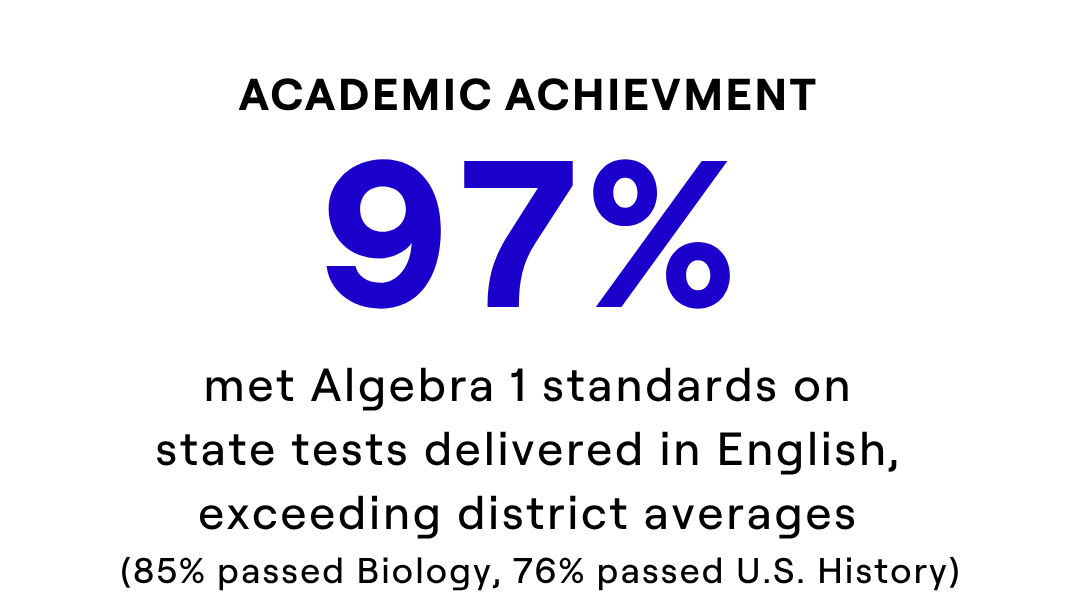
Schools serving English learners need to plan for two distinct timelines — content mastery and formal English proficiency. In 2024, La Promesa students achieved strong academic results on state assessments delivered in English, with 85% passing Biology, 76% passing U.S. History, and 97% meeting Algebra I standards — among highest in the district. Yet only 13% advanced one level on the English language proficiency state test.
The gap showed that students can fully grasp grade-level concepts while still developing academic English. In response, La Promesa adjusted its course sequence, moving Biology to 10th grade and adding Environmental Science in 9th to provide more time for language growth before taking high-stakes testing. The school now celebrates both kinds of progress, recognizing that academic achievement often precedes measurable language gains.